In this guide
- Repeated attempts need a chronology
- Use approved references
- Distinguish observation from interpretation
- Avoid counting references as completed payments
- A hypothetical busy checkout
- Keep the recovery action out of the service guess
- Provide a useful customer record
- Learn from the pattern
- Worked example: a timeout followed by a second attempt
- Reusable work card
- Sources and scope
- Continue with a different task
Create a clear merchant-side record when a customer or cashier sees more than one attempt.
Repeated attempts need a chronology
A customer may report that the terminal was used more than once or that an online checkout was retried. The first task is to establish what the merchant system recorded for each attempt. Do not assume that every attempt became a completed payment or that an uncertain attempt can safely be repeated.
Use approved references
Record the order, approximate sequence and merchant transaction references through the business’s authorized process. Keep the customer’s full card number, PIN and account screenshots out of a general service log. Staff should be able to explain the sequence using merchant-controlled evidence.
Distinguish observation from interpretation
“The terminal displayed an error” is an observation. “No payment occurred” is a conclusion that may need system confirmation. Label the difference. If the merchant cannot establish the state, ask its processor through the approved route before initiating another payment or a corrective action.
Avoid counting references as completed payments
A system may generate identifiers for attempts, orders, authorizations or other events. Staff need the approved meaning of each before adding them together. Two references with the same amount are a reason to investigate, not proof of a duplicate completed payment. Conversely, one order confirmation does not prove no other relevant payment event exists. The merchant’s authorized system or processor owner should interpret the record. This prevents a service agent from offering an unsupported explanation based on a superficial count, while preserving the customer’s ability to report an account concern through the verified official channel.
A hypothetical busy checkout
A cashier sees a timeout and a customer offers a second card. Before taking another action, the staff member follows the merchant’s procedure for an uncertain attempt. If a supervisor is needed, the handoff includes the order and attempt references. The process should not depend on the customer exposing their entire card-account history at the counter.
Keep the recovery action out of the service guess
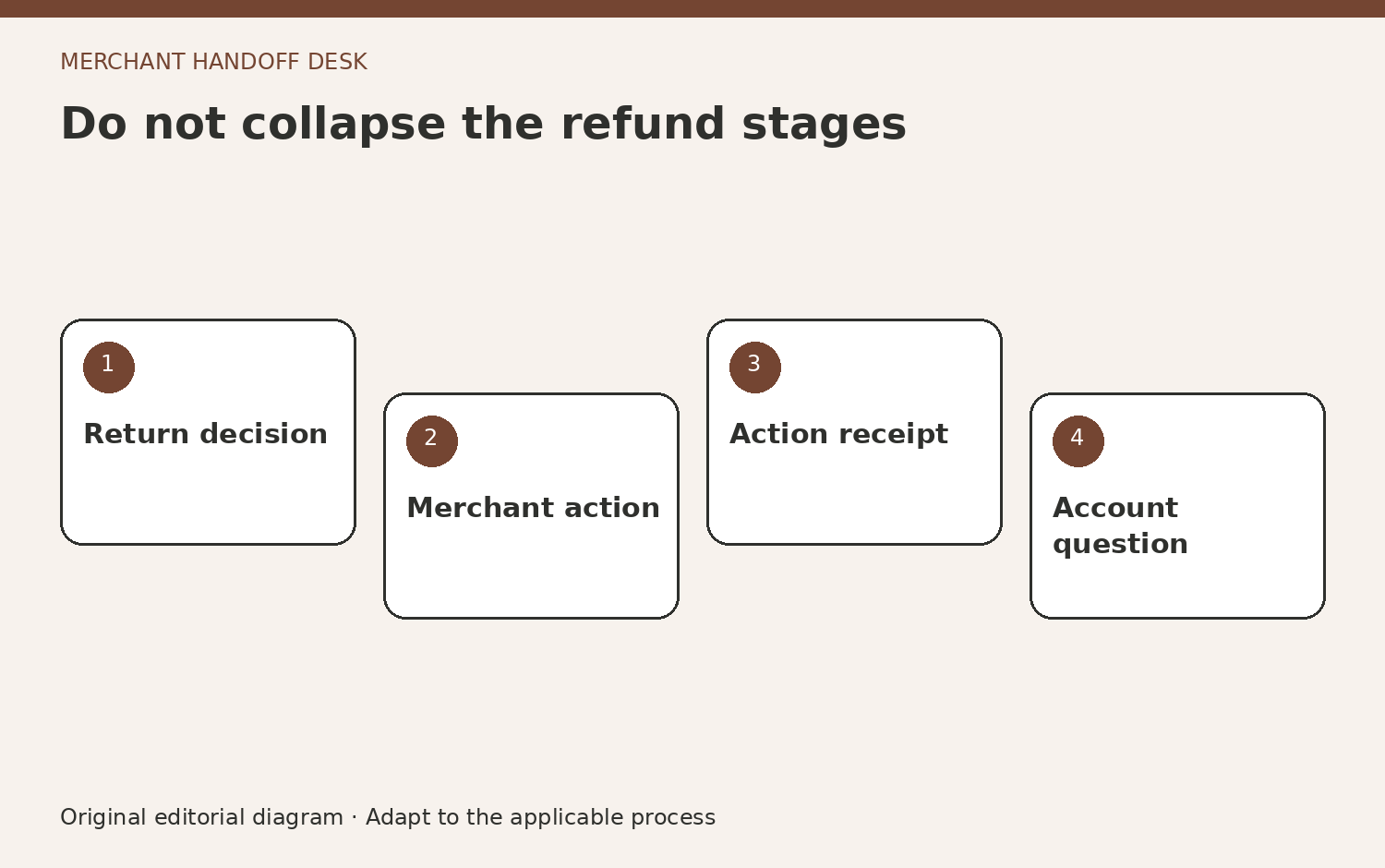
A well-intentioned agent may want to issue a refund immediately to resolve uncertainty. That can create a new event before the business understands the original ones. Use the merchant’s approved process to establish the state and obtain the appropriate authorization for any correction. The service agent can still help promptly by gathering merchant references, explaining the open question and assigning an owner. Speed should come from a clear handoff, not from an unreviewed payment action. The worked example below illustrates the evidence sequence without supplying technical commands or suggesting that every timeout behaves alike.
Provide a useful customer record
Once the merchant establishes its actions, give the customer the appropriate receipts or written explanation. If two completed merchant payments are identified, follow the business’s authorized correction process. Do not promise a card-account outcome before it is established by the relevant service.
Learn from the pattern
If repeated attempts recur at a terminal or checkout stage, report the aggregate pattern to the system owner. Use synthetic examples for training. The lesson should improve the merchant’s handling of uncertainty rather than blaming customers for a confusing interface or assuming a particular prepaid brand caused the problem.
Worked example: a timeout followed by a second attempt
A fictional customer tries to complete an online order. The first attempt displays a timeout, and a later attempt produces an order confirmation. The customer asks whether they paid twice. Staff should treat the timeout and confirmation as observations, then consult the merchant’s actual records to determine what each event represents.
The order lookup finds the confirmed order and sale reference B-02. A separate attempt reference B-01 exists, but its meaning is unclear to the service agent. The agent records both references and asks the authorized system or processor owner to interpret B-01. The existence of two references does not itself establish two completed payments.
The customer receives the confirmed sale receipt and an explanation that the earlier merchant event is being reviewed. The agent does not ask for a password or browse the customer’s app. If the customer independently believes an account error occurred, the merchant should not discourage prompt use of the verified cardholder reporting process.
Only after the merchant’s state is established can the responsible operator decide whether any authorized correction is appropriate. The service agent does not initiate a speculative refund for the unclear attempt, because an unverified correction can add another event to an already confusing record.
The reusable lesson is to preserve the sequence and label uncertainty. A fast explanation that invents certainty is less helpful than a precise record with an accountable next owner. The example supplies no processor commands and makes no claim that all checkout timeouts behave the same way.
The final merchant note can preserve two lines: B-02 is the confirmed sale supported by its receipt; B-01 remains assigned for interpretation until the authorized owner supplies a finding. If B-01 is later explained, add the evidence and date rather than deleting the original uncertainty. A new agent can then continue the case without making the customer retell the whole story or assuming the first agent already resolved both events. This is the concrete service benefit of a chronological record.
Reusable work card
Use these prompts in your organization’s approved process. They request no private account information and do not authorize a payment or account change.
- Create a sequence of the attempts using merchant references and the actual observed terminal or checkout results.
- Separate an error display from a conclusion that no payment event occurred.
- Follow the approved uncertain-transaction process before another payment or correction is attempted.
- Keep credentials and unrelated account screenshots out of the general service log.
- Provide receipts or a written merchant finding once the business establishes its recorded actions.
- Report repeated system patterns to the responsible owner using aggregate evidence and synthetic training examples.