In this guide
- A status needs a source
- Describe what the business knows
- Ask the processor an exact question
- Use a small internal glossary tied to the actual system
- A hypothetical cancelled order
- Handle a changed status without rewriting the earlier observation
- Give a bounded update
- Use careful closing language
- Reusable work card
- Sources and scope
- Continue with a different task
Translate a merchant system status into a careful customer explanation without guaranteeing account timing.
A status needs a source
Words such as pending, completed and cancelled can mean different things in an order system, payment processor and cardholder account. Staff should identify which system produced the word before explaining it. The customer’s card branding does not determine the meaning of a merchant’s internal status label.
Describe what the business knows
A useful statement says what action the merchant recorded and when. It should not infer that funds are available or that an account entry will disappear at a particular time unless the responsible service has confirmed that outcome. Network processing documents show that payment events have technical distinctions; they are not a substitute for the merchant’s current processor guidance.
Ask the processor an exact question
If the merchant record is unclear, use the approved support route and supply the relevant merchant transaction reference. Ask what the status means and what action, if any, is appropriate. Do not repeatedly retry or reverse transactions based on a guess. This publication provides no terminal commands or network-message instructions.
Use a small internal glossary tied to the actual system
A merchant can maintain a short approved glossary explaining its own common status labels, the evidence each label provides and the owner for unclear cases. Include the system and version context so staff do not transfer a label’s meaning from one platform to another. A label may concern an order workflow rather than payment processing. The glossary should be reviewed by the responsible system owner and should not be created by guessing from a public article. This publication’s examples show why the distinction matters; they do not supply definitions for a particular Corpay, processor or merchant interface.
A hypothetical cancelled order
An order is cancelled in the shop’s fulfilment system, but the payment record still shows an unresolved event. Staff should investigate whether the cancellation also caused a payment action under the actual workflow. Telling the customer “it is cancelled” without naming the system may create false confidence.
Handle a changed status without rewriting the earlier observation
A status may change while a service enquiry is open. Record what staff observed at the relevant times and what the later evidence establishes. Do not quietly replace the first note in a way that makes the customer’s earlier concern look unreasonable. A chronology can explain that the merchant initially could not confirm an action and later obtained the needed record. That is a normal evidence update, not a reason to pretend the answer was known all along. The customer update should distinguish the new finding from any account result still outside the merchant’s visibility.
Give a bounded update
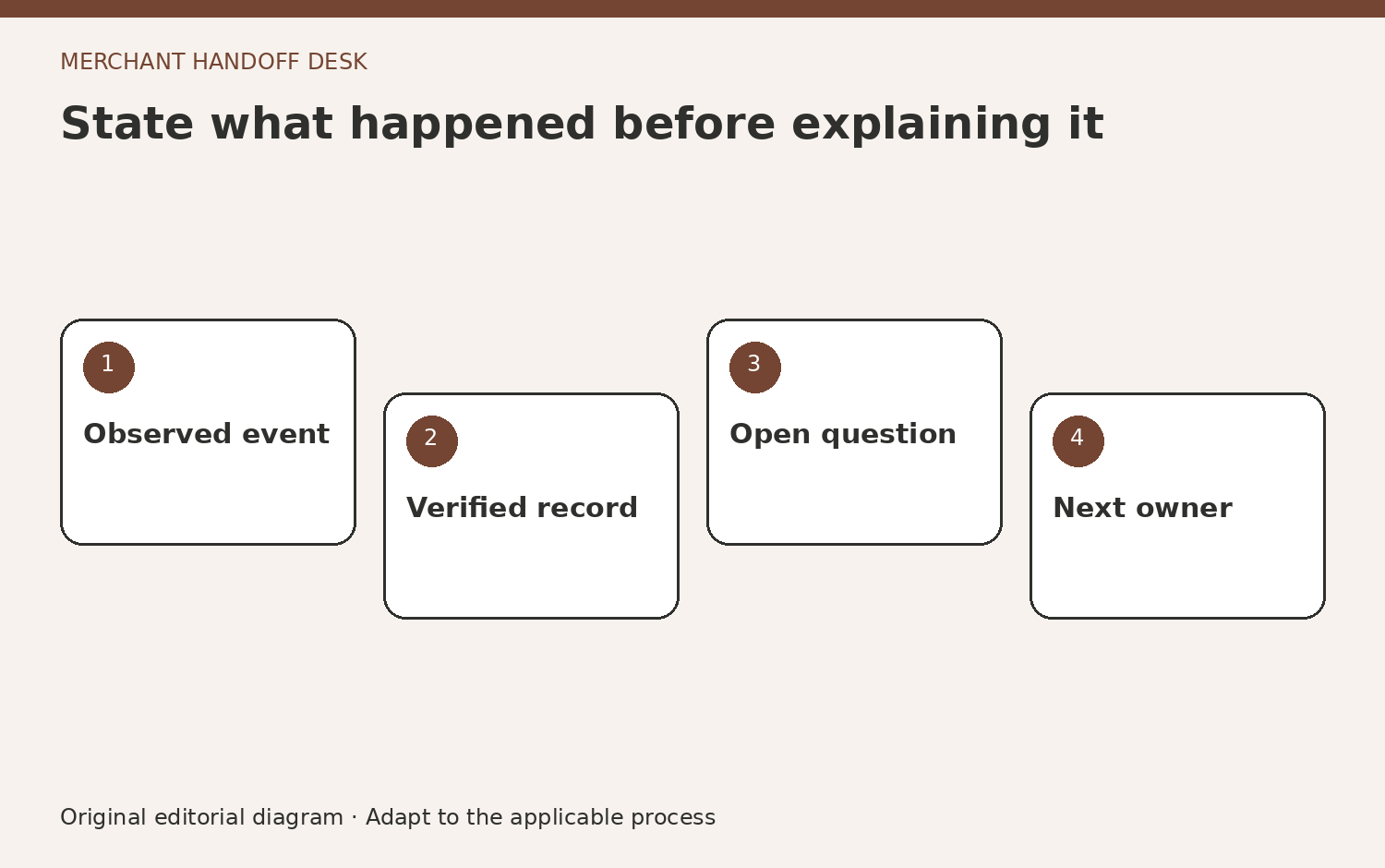
Explain the checked record, the unresolved question and who is reviewing it. If the customer believes there is an account error, do not discourage prompt contact with the verified cardholder channel. The merchant’s internal investigation and the customer’s account-reporting rights are separate matters.
Use careful closing language
“Our system records this action” is narrower than “your money is back.” Keep that distinction in emails and printed notes. Do not publish a universal release period for Fintwist or Corpay Prepaid cards; this source review did not establish one for every program and purchase context.
Reusable work card
Use these prompts in your organization’s approved process. They request no private account information and do not authorize a payment or account change.
- Identify the system that produced the status word before explaining what it means.
- Confirm the merchant action from the actual record rather than inferring it from an order label.
- Ask the processor an exact status question through the business’s approved support route when needed.
- Avoid repeated or corrective payment actions while the current state remains uncertain.
- Tell the customer what is established, what remains open and who is reviewing the unresolved point.
- Do not promise a fixed account release or credit time unless appropriately verified guidance supports that exact scope.